
What are Web3 prediction markets and why do they matter?
- Understanding what Web3 prediction markets actually are
- How these markets actually work
- Why Web3 instead of traditional platforms
- The major platforms in this space
- What people actually trade on
- The real advantages of these platforms
- The risks you need to understand
- What this means for the future
- Key things to remember
If you’ve spent any time in crypto circles lately, you’ve probably heard people talking about prediction markets. But what are Web3 prediction markets exactly, and why are they becoming such a big deal in the blockchain world?
In this article, I’ll break down everything you need to know about these platforms. We’ll cover how they work, why people use them, and what makes them different from traditional betting or forecasting platforms. Whether you’re completely new to crypto or just curious about this corner of the blockchain world, I’ll keep things simple and practical.
Understanding what Web3 prediction markets actually are
Let’s start with the basics. Web3 prediction markets are decentralized platforms where people can trade on the outcomes of future events. Think of them as crowd-sourced forecasting tools where users put real money behind their predictions.
Unlike traditional betting sites or prediction platforms, these markets run on blockchain technology. Smart contracts automatically handle everything from trades to payouts. There’s no central company holding your funds or deciding who wins.
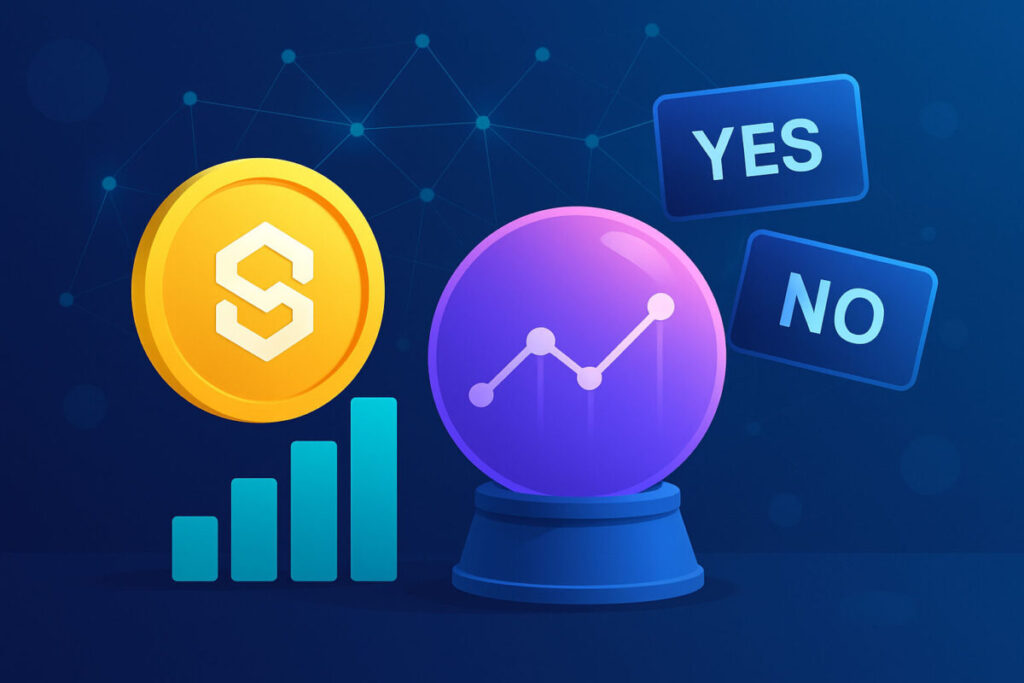
The concept is straightforward. If you think a certain event will happen, you buy shares that say “YES.” If you think it won’t happen, you buy “NO” shares. The market price reflects what the crowd collectively believes is the probability of that event occurring.
Here’s a simple example. Say there’s a market asking “Will Bitcoin hit $100,000 by the end of 2025?” If YES shares are trading at $0.65, the market is essentially saying there’s a 65% chance it happens. If new information comes out that makes people more bullish, those shares might jump to $0.80, indicating an 80% probability.
How these markets actually work
The mechanics are simpler than you might think. When you trade on a Web3 prediction market, you’re buying shares that represent possible outcomes. Each share pays out $1 if that outcome happens, or $0 if it doesn’t.
Let’s walk through an example. You see a market asking whether Ethereum will reach $5,000 in the next three months. YES shares are currently priced at $0.40 each. You think it’s more likely than that, so you buy 100 YES shares for $40 total.
If Ethereum hits $5,000, each of your shares becomes worth $1. You can cash out for $100, making a $60 profit. If it doesn’t reach that price, your shares expire worthless and you lose your $40.
The prices move constantly based on supply and demand. As more people buy YES shares, the price goes up. As people sell or buy NO shares, the price goes down. This creates a real-time probability signal based on where people are willing to put their money.
Smart contracts handle everything automatically. Once the event resolves, the contract checks the outcome and distributes winnings to the correct shareholders. No middleman, no delays, no disputes about who won.
Why Web3 instead of traditional platforms
You might be wondering why we need blockchain for this. After all, traditional betting sites and prediction platforms have existed for decades. The difference comes down to a few key advantages that Web3 brings to the table.
First is decentralization. No single company controls the platform or holds custody of your funds. The smart contracts live on the blockchain, and they execute automatically based on predetermined rules. This removes counterparty risk and censorship concerns.
Access is another huge factor. Most Web3 prediction markets are globally accessible without requiring identity verification or approval from a central authority. Anyone with a crypto wallet can participate, regardless of where they live.
Transparency is built into the system. Every trade, every outcome, every payout happens on-chain where anyone can verify it. You don’t have to trust a company’s internal systems or worry about them manipulating odds.
Fees tend to be lower too. Traditional platforms need to cover operational costs and take a profit margin. Decentralized markets often charge minimal fees just to cover blockchain transaction costs. The lack of a traditional bookmaker margin means better odds for participants.
Finally, there’s the permissionless nature of market creation. On traditional platforms, a company decides what markets to offer. On Web3 platforms, anyone can create a market on virtually any topic, as long as there’s a way to verify the outcome.
The major platforms in this space
Several platforms have emerged as leaders in the Web3 prediction market space. Each has its own approach and features.
Polymarket has become the most popular option, especially for US politics and current events. It runs on Polygon and offers markets on everything from elections to entertainment to crypto price movements. The platform uses USDC for trading and has a clean, user-friendly interface that makes it accessible even for beginners.
Augur was one of the pioneers, launching on Ethereum back in 2018. It’s fully decentralized and allows anyone to create markets on any topic. Augur uses a reputation token system for dispute resolution when market outcomes are unclear.
Zeitgeist operates on its own blockchain using Substrate technology. It focuses on prediction markets as a tool for forecasting and decision-making, not just speculation. The platform emphasizes governance and community-driven market creation.
Other platforms like Gnosis Conditional Tokens and Omen have also made their mark, each with different technical approaches and target audiences. The space continues to evolve as new platforms emerge and existing ones improve their offerings.
What people actually trade on
The range of markets on these platforms might surprise you. While crypto price predictions are popular, they’re far from the only option.
Political markets see massive volume, especially during election seasons. People trade on everything from presidential races to congressional seats to international elections. These markets often aggregate information faster than traditional polls.
Sports betting is another major category. You’ll find markets on NFL games, soccer matches, basketball tournaments, and pretty much any major sporting event. The decentralized nature means more flexibility in market types compared to traditional sportsbooks.
Crypto-specific markets go beyond simple price predictions. People trade on protocol launches, exchange listings, network upgrades, and technical milestones. If there’s a verifiable outcome in the crypto world, someone has probably created a market for it.
Tech and AI developments have become increasingly popular topics. Markets exist for things like when GPT-5 will launch, whether certain AI capabilities will be achieved, and which companies will hit specific milestones.
Economic indicators like Fed interest rate decisions, inflation data, and employment numbers also attract traders who want to bet on or hedge against economic outcomes.
The real advantages of these platforms
Beyond the technical features, Web3 prediction markets offer some compelling benefits for users and researchers alike.
They aggregate information incredibly efficiently. When thousands of people put real money behind their predictions, you get a probability signal that often outperforms expert forecasts or traditional polls. The wisdom of the crowd becomes financially weighted wisdom.
Settlement is fast and automatic. Once an event resolves, smart contracts process payouts immediately. No waiting for a company to verify results or process withdrawals. If you won, you can access your funds right away.
The lack of centralized control means markets can exist on controversial topics that traditional platforms might avoid. As long as there’s a verifiable outcome, the market can operate regardless of political or corporate sensitivities.
Community-driven forecasting turns out to be remarkably accurate in many cases. Academic research has shown that well-functioning prediction markets often beat expert predictions, especially when there’s sufficient liquidity and participation.
For researchers and decision-makers, these platforms provide valuable data. Market prices offer real-time probability estimates that can inform strategy, planning, and risk assessment in ways that traditional forecasting methods can’t match.
The risks you need to understand
Like anything in crypto, Web3 prediction markets come with risks that you should understand before participating.
Smart contract vulnerabilities are always a concern. While major platforms undergo security audits, bugs can still exist. If a contract has a flaw, it could potentially be exploited, leading to lost funds.
Market manipulation becomes easier in low-liquidity markets. If a market doesn’t have much trading volume, a single large trader could potentially move prices significantly, creating misleading probability signals.
Regulatory uncertainty hangs over the space. Different jurisdictions view prediction markets differently, and regulations could change. Some platforms have faced legal challenges or restricted access to certain regions.
Trading carries financial risk, just like any form of speculation or betting. You can lose money if your predictions are wrong. Markets don’t always reflect true probabilities, especially when liquidity is thin or information is limited.
Not every market achieves high accuracy. While crowd wisdom works well in many cases, it’s not perfect. Markets can be wrong, especially about low-probability events or topics where information is scarce or biased.
Oracle problems can arise when determining outcomes. Who decides what the “true” outcome is? While most platforms have dispute resolution mechanisms, edge cases and ambiguous outcomes can cause issues.
What this means for the future
Web3 prediction markets represent an interesting evolution in how we forecast and aggregate information. By combining blockchain technology with market mechanics, these platforms create tools that are more accessible, transparent, and often more accurate than traditional alternatives.
For regular users, they offer a way to profit from knowledge or insights about future events. For researchers and decision-makers, they provide valuable probability data. For the crypto ecosystem, they demonstrate a practical use case for blockchain beyond just currency or speculation.
The technology continues to improve. User interfaces are getting better, liquidity is increasing, and more people are discovering these platforms. As the space matures, we’ll likely see prediction markets become more integrated into mainstream forecasting and decision-making.
Whether you’re interested in testing your predictive abilities, hedging against future outcomes, or simply exploring what blockchain technology can do, Web3 prediction markets offer an accessible entry point. They’re not perfect, and they’re not for everyone, but they represent a genuine innovation in how we can collectively forecast the future.
As someone who’s spent years analyzing both traditional markets and crypto, I find the intersection fascinating. These platforms take age-old market principles and apply them in new ways that simply weren’t possible before blockchain technology.
Key things to remember
So, what are Web3 prediction markets? They’re decentralized platforms where people trade on future events using blockchain technology and smart contracts. They offer transparency, accessibility, and often accurate probability signals through crowd-sourced forecasting.
These markets matter because they demonstrate a practical application of blockchain beyond cryptocurrency trading. They provide tools for forecasting, risk management, and information aggregation that work differently than traditional platforms.
Whether they’ll become mainstream remains to be seen. But for now, they offer an interesting glimpse into how decentralized technology can create new ways of collectively predicting and preparing for the future.
If you’re curious about trying them, start small. Explore the major platforms, understand how they work, and maybe place a small trade on something you have knowledge about. Like anything in crypto, don’t risk more than you can afford to lose, and take time to understand what you’re getting into.
Disclaimer: This article is for informational purposes only and does not represent financial or betting advice.