
Forecasting vs predicting: what’s the difference?
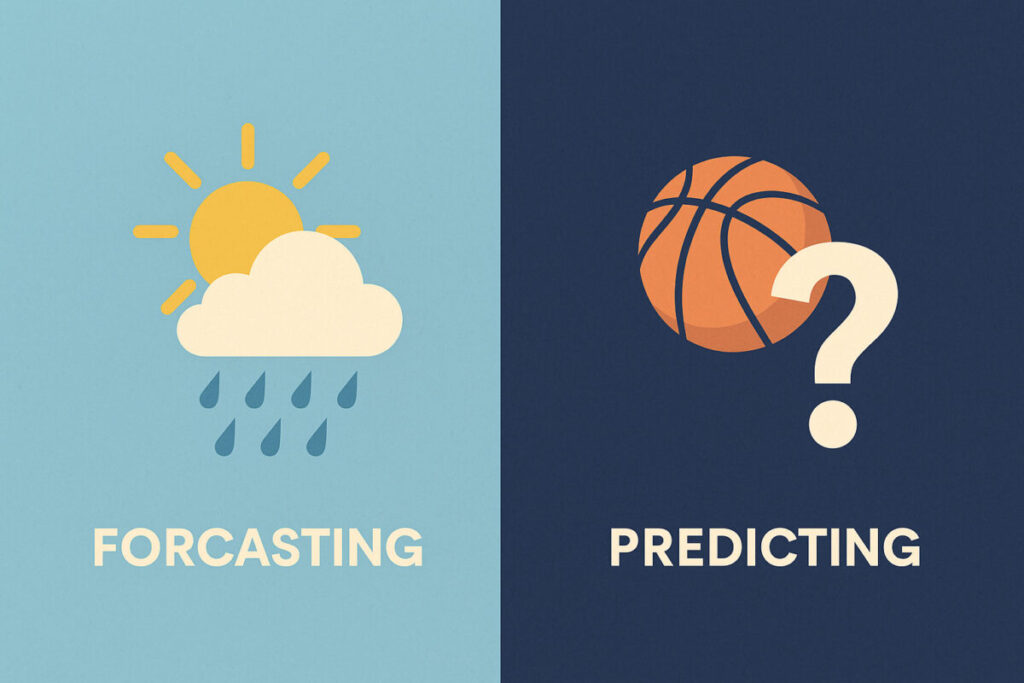
You’ve probably heard people use the words “forecasting” and “predicting” like they mean the same thing. And honestly, in casual conversation, that’s fine. But if you’re trying to understand how markets work, how weather reports are made, or why some guesses are more reliable than others, knowing the difference between forecasting vs predicting actually matters.
In this article, I’ll break down what each term really means, show you clear examples, and explain why the distinction is important in real life. No complicated jargon, just straightforward explanations.
What is predicting?
A prediction is essentially a guess about what will happen in the future. It’s usually a single, definitive statement. Someone makes a prediction based on their intuition, experience, or personal opinion.
Here’s the thing about predictions: they don’t require any structured data or formal analysis. You can make a prediction just by going with your gut feeling. For example, you might say “I think Bitcoin will hit $100,000 by next year” or “The Lakers will win the championship.”
Predictions are often absolute. They’re yes-or-no statements without much room for nuance. Either something will happen or it won’t, according to the prediction.
What is forecasting?
Forecasting is different. A forecast is a data-driven estimation of what’s likely to happen based on evidence, trends, and statistical analysis.
When someone creates a forecast, they’re usually looking at historical data, identifying patterns, and using that information to project future outcomes. Forecasts typically include probabilities or ranges rather than absolute statements.
For instance, instead of saying “it will rain tomorrow,” a weather forecast might say “there’s a 70% chance of rain tomorrow based on current atmospheric conditions and historical weather patterns.” See the difference? The forecast acknowledges uncertainty and gives you a probability.
Forecasts are structured. They follow methods and models that can be reviewed and tested. This makes them more reliable for making important decisions.
Key differences between forecasting and predicting
Let me lay out the main differences in simple terms.
Predictions are single outcomes, forecasts are probabilities. When you predict, you’re saying “this will happen.” When you forecast, you’re saying “this is likely to happen, with X% probability.”
Predictions are opinion-driven, forecasts are data-driven. Predictions can come from anywhere—your gut, your beliefs, your hopes. Forecasts require actual evidence and analysis.
Predictions don’t require evidence, forecasts rely on it. You can make a prediction without showing your work. A forecast needs to be backed up by data and methodology.
Predictions are absolute, forecasts acknowledge uncertainty. Predictions treat the future as certain. Forecasts recognize that the future is uncertain and try to quantify that uncertainty.
Why the distinction matters
Understanding the difference between forecasting and predicting isn’t just academic. It has real implications for how you make decisions.
In finance and investing, forecasts help you evaluate risk properly. If an analyst says “I predict this stock will double,” that’s just their opinion. But if they say “based on earnings growth and market conditions, there’s a 30% probability this stock will gain 50% or more in the next year,” you can actually use that information to manage risk.
In business planning, forecasting is essential. Companies need to forecast sales, expenses, and market conditions to make smart decisions about hiring, inventory, and growth strategies. A prediction like “sales will be great next quarter” doesn’t help much. A forecast that projects “sales are likely to grow 15-20% based on seasonal trends and pipeline data” gives you something to work with.
In sports betting, the difference is huge. Anyone can predict who’ll win the Super Bowl. But professional odds-makers create forecasts using player statistics, team performance data, and historical matchups to set betting lines that reflect actual probabilities.
Even in weather reporting, you can see this in action. A prediction might be “it will snow on Thursday.” A forecast tells you “there’s a 40% chance of 2-4 inches of snow Thursday afternoon based on current storm tracking.”
Examples showing both
Let me show you how predictions and forecasts look side by side in different scenarios.
- Stock market example: A prediction would be “Tesla stock will hit $500 next month.” A forecast would be “Based on current volatility, earnings projections, and market conditions, Tesla has a 25% probability of reaching $500 within the next 30 days, with a more likely range of $380-$450.”
- Weather example: A prediction says “It’s going to rain on Saturday.” A forecast says “There’s a 65% chance of precipitation Saturday afternoon, with rainfall likely between 0.5 and 1.5 inches based on current atmospheric pressure systems and moisture levels.”
- Sports example: A prediction states “The home team will win tonight.” A forecast states “The home team has a 58% win probability based on recent performance metrics, head-to-head history, and current roster strength.”
Notice how the forecasts always include some measure of probability or range? That’s the key difference. Forecasts give you more useful information for decision-making.
Know the bottom line
The bottom line is this: predicting is making a single guess, while forecasting is using data to estimate probabilities and ranges. Both have their place, but when you’re making important decisions about money, business, or planning, forecasts give you much better information to work with.
Next time someone tells you their prediction, ask yourself: is this based on data and methodology, or is it just an opinion? Understanding this difference will help you evaluate information more critically and make smarter decisions.
Whether you’re looking at crypto markets, traditional stocks, or just trying to decide if you need an umbrella tomorrow, knowing the difference between a prediction and a forecast can save you from costly mistakes.